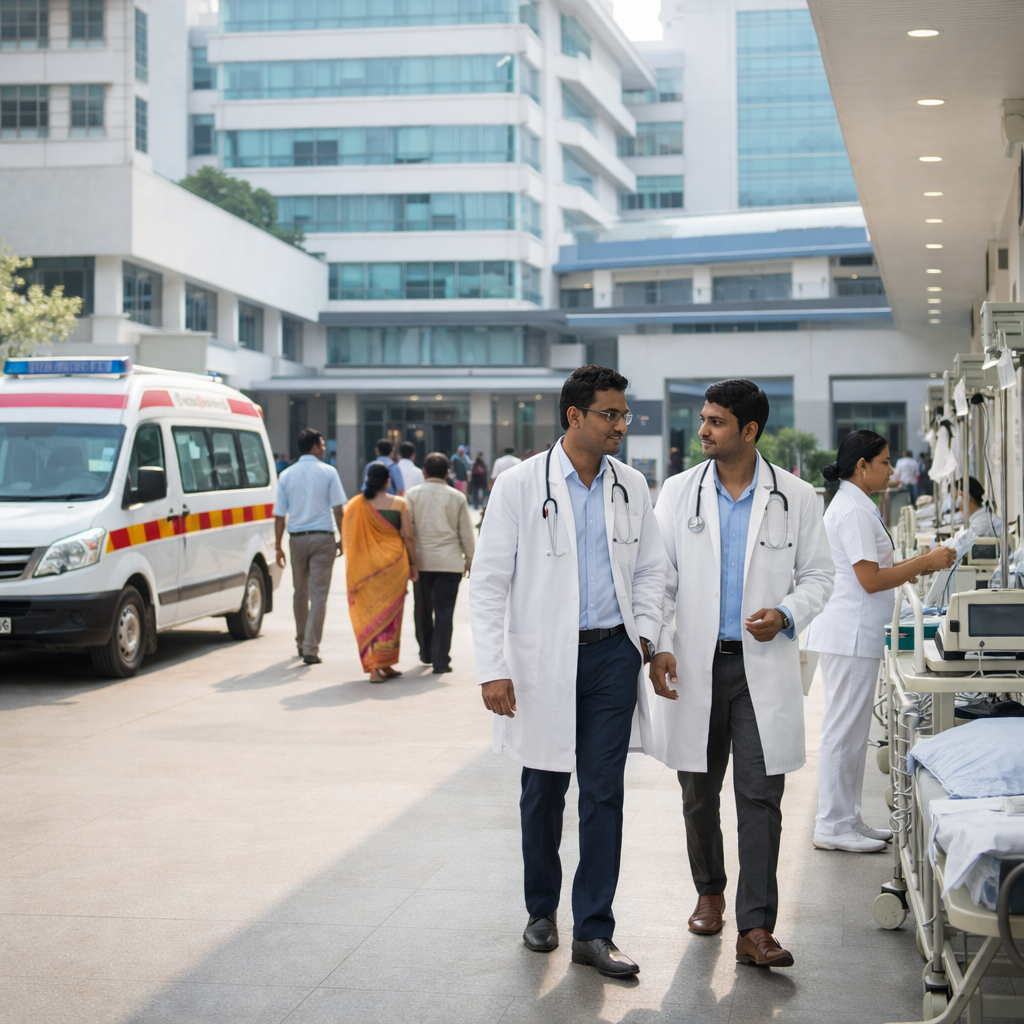
Introduction: Healthcare as a Daily Reality for Millions
Healthcare in India is not just a policy issue—it is a daily reality that affects every household. From crowded government hospitals to expensive private clinics, India’s healthcare system reflects deep contrasts. While medical technology has advanced rapidly, access and affordability remain major concerns for common citizens.
India follows a mixed healthcare model, where public hospitals coexist with a fast-growing private healthcare sector. For millions, especially the poor and middle class, navigating this system is challenging. Rising medical costs, unequal access, and overburdened public facilities have made healthcare one of the most debated social issues in the country.
This article examines public hospitals in India, private healthcare costs, and how common citizens experience the healthcare system, while also exploring government initiatives, challenges, and the road ahead.
Overview of the Indian Healthcare System
A Mixed Public–Private Model
India’s healthcare system is divided into two main segments:
- Public healthcare (government-funded hospitals and clinics)
- Private healthcare (privately owned hospitals, clinics, and diagnostic centers)
Public hospitals aim to provide affordable or free healthcare, while private hospitals focus on advanced care—often at high costs. This dual structure creates significant inequality in healthcare access.
Public Healthcare in India: Strengths and Limitations
Role of Government Hospitals
Public hospitals form the backbone of healthcare for low-income and rural populations. They offer services such as:
- Free or subsidized consultations
- Low-cost medicines
- Emergency and maternal care
- Vaccination and disease control programs
For many citizens, government hospitals are the only affordable option.
Overcrowding and Infrastructure Challenges
Despite their importance, public hospitals face serious challenges:
- Overcrowding and long waiting times
- Shortage of doctors and nurses
- Limited diagnostic facilities
- Aging infrastructure
In urban areas, a single government hospital may serve patients from multiple districts, putting immense pressure on resources.
Rural Healthcare Gap
Rural India faces a significant healthcare access gap. Many villages lack:
- Primary health centers with full staff
- Emergency transport
- Specialist doctors
As a result, rural citizens often travel long distances for basic medical care, increasing both cost and risk.
Private Healthcare in India: Quality at a Cost
Growth of the Private Healthcare Sector
Private hospitals have expanded rapidly over the last two decades. They are known for:
- Modern infrastructure
- Advanced medical technology
- Shorter waiting times
- Specialized treatments
India has also become a hub for medical tourism due to its high-quality private healthcare facilities.
Rising Cost of Private Healthcare
While private hospitals offer better facilities, the cost of private healthcare in India is a major concern.
Common issues include:
- High consultation and admission fees
- Expensive diagnostic tests
- Costly surgeries and ICU care
- Lack of transparent billing
A single hospitalization can push middle-class families into debt, making healthcare a leading cause of financial stress.
Out-of-Pocket Expenditure
India has one of the highest out-of-pocket healthcare expenditures globally. This means citizens pay directly for medical care rather than through insurance.
Consequences:
- Families sell assets or take loans
- Medical emergencies lead to poverty
- Long-term treatments become unaffordable
The Common Citizen’s Healthcare Experience
Middle-Class Struggles
The middle class often falls between public and private healthcare systems. While public hospitals may be overcrowded, private hospitals are often unaffordable.
Common middle-class concerns:
- Limited insurance coverage
- Rising premiums
- Unpredictable medical bills
- Lack of price regulation
This group bears a significant financial burden during health emergencies.
Healthcare Access for the Poor
Low-income families depend heavily on public healthcare. However:
- Medicine shortages force them to buy drugs externally
- Diagnostic tests may not be available on-site
- Travel and wage loss add indirect costs
Healthcare access remains closely linked to income and location.
Health Insurance in India: A Partial Safety Net
Government Health Schemes
To reduce financial burden, the government has introduced health insurance schemes like Ayushman Bharat, which aims to provide coverage to economically weaker sections.
Benefits include:
- Cashless treatment at empaneled hospitals
- Coverage for major procedures
- Reduced out-of-pocket spending
Limitations of Health Insurance
Despite progress, insurance coverage has gaps:
- Limited awareness among citizens
- Exclusions and caps on treatment costs
- Fewer private hospitals accepting government schemes
Insurance helps, but it does not fully eliminate financial risk.
Healthcare Workforce: Doctors, Nurses, and Staff
Shortage of Medical Professionals
India faces a shortage of healthcare workers, especially in rural areas.
Key challenges:
- Uneven distribution of doctors
- High workload and burnout
- Migration of skilled professionals abroad
Strengthening the healthcare workforce is essential for improving service delivery.
Preventive Healthcare and Public Awareness
Focus on Treatment Over Prevention
India’s healthcare system is largely treatment-oriented. Preventive care such as:
- Regular health screenings
- Lifestyle disease prevention
- Mental health awareness
often receives less attention, leading to higher long-term healthcare costs.
Urban–Rural Divide in Healthcare
Urban areas benefit from:
- Multiple hospitals and specialists
- Better emergency services
Rural areas struggle with:
- Limited facilities
- Shortage of trained staff
- Poor infrastructure
Bridging this divide is critical for equitable healthcare.
Healthcare and Technology in India
Digital Health and Telemedicine
Technology is slowly transforming healthcare delivery:
- Telemedicine connects rural patients to specialists
- Digital health records improve efficiency
- Online consultations reduce travel costs
However, digital healthcare adoption depends on internet access and digital literacy.
Regulatory Challenges in Healthcare
Lack of Cost Transparency
One of the biggest concerns is the absence of standardized pricing in private hospitals. Patients often receive:
- Itemized bills without prior estimates
- Unexpected charges during treatment
Stronger regulation can improve trust and affordability.
Impact of Healthcare Costs on Society
High healthcare costs affect:
- Household savings
- Education spending
- Overall quality of life
Medical expenses are a major reason families fall into long-term debt.
Role of State Governments in Healthcare
Healthcare is primarily a state responsibility in India. States differ widely in:
- Public hospital quality
- Health spending
- Insurance implementation
States that invest more in healthcare generally show better health outcomes.
Healthcare Inequality and Social Justice
Access to healthcare often depends on:
- Income
- Location
- Gender
- Social background
Reducing healthcare inequality is essential for inclusive development.
Future of Healthcare in India
What Needs to Change
For a stronger healthcare system, India needs:
- Increased public health spending
- Strengthened primary healthcare
- Regulation of private healthcare costs
- Universal health coverage
Healthcare reform must focus on affordability, accessibility, and quality.
The Role of Citizens in Healthcare Improvement
Citizens can contribute by:
- Raising awareness about rights and schemes
- Supporting preventive healthcare
- Demanding transparency and accountability
Public participation strengthens healthcare governance.
Conclusion: Healthcare at the Crossroads
Healthcare in India stands at a critical crossroads. While medical expertise and technology have advanced, access and affordability remain uneven. Public hospitals continue to serve millions despite limited resources, while private healthcare offers quality at a price many cannot afford.
For common citizens, healthcare often becomes a test of financial resilience. Bridging the gap between public care and private costs requires sustained policy focus, investment, and accountability.
A healthier India is not just about hospitals—it is about fair access, affordable care, and dignity for every citizen.